Comments
Water over Oil – Water Security Threats in the Persian Gulf States During the Middle East Conflict
A blockade of the Strait of Hormuz has a significant impact on global oil and ga...


22.04.2026
Ukrainian attacks are being carried out at a time when global oil prices are surging in response to the crisis triggered along the USA–Israel–Iran axis. The effective blockade of the Strait of Hormuz and the threat to hydrocarbon export facilities in the Persian Gulf create an opportunity for Russia to increase revenues from the sale of resources subject to Western sanctions. Ukrainians are not remaining passive in the face of the prospect of rising Russian revenues and the potential improvement of their financial performance, and thus their capacity to finance war expenditures.
Both sides are also engaging in activities in the Middle East, primarily by providing highly valuable experience in both attacking and defending critical infrastructure. Intelligence information and “know-how” in the combat use of drones (a Russian development of Iranian Shahed platforms) and ballistic missiles, as well as principles for protecting energy infrastructure (not only related to the extraction and export of hydrocarbons, but also desalination plants and chemical facilities) against coordinated aerial attacks, constitute a specific form of commodity in the crisis-affected region. This creates an opportunity for Ukraine to increase the interest of Arab states in the war of attrition it is waging with Russia and to strengthen diplomatic relations necessary for securing support for Ukraine’s reconstruction. Russia, in turn, is to some extent improving its image as a partner in its relations with Iran, in light of the lack of overt actions in the initial days of the US–Israeli air campaign against Iran.
Direct attacks
Ukrainian pressure on the Russian resource sector includes attacks on refineries, storage facilities, and — particularly observed in recent weeks — export terminals. Some of the attacks have targeted oil pumping stations: NPS-3, NPS Andreapol, and NPS-7. Strikes on this type of installation along the pipeline system supplying the oil terminal in Ust-Luga, although not directed at port terminals themselves, affect their throughput. These actions, therefore, encompass the entire logistics chain and focus on its most critical elements. Ukrainian targets also include vessels of the shadow fleet in the Baltic Sea, the Black Sea, and the Mediterranean Sea (the LNG tanker Arctic Metagaz). The development of drone technologies enables the Ukrainian side to strike, first, terminals located at significant distances from its own borders (in the case of Russian Baltic ports targeted by Ukraine, distances of approximately 900–1,000 km), and second, well-protected facilities. Long-range Ukrainian drone operations reach up to 2,000 km into the adversary’s territory. According to Russian reports, during a nighttime attack on the port of Primorsk in March 2026, approximately 250 Ukrainian drones were neutralized over the Moscow, Leningrad, and Kursk regions. Ukraine reportedly deployed 300 drones.
The strikes carried out against Russian maritime terminals especially deserve several comments. The Baltic ports of the Russian Federation alone account for 45% of seaborne crude oil exports. This volume is supplemented by a further 40% from terminals in the Black Sea. The Ust-Luga terminal (the largest transshipment port in the Baltic and the second largest in Russia) handles approximately 700,000 barrels of crude oil and petroleum products per day (in 2025, 33 million tons of crude were exported through this route). Ust-Luga receives supplies via the BTS-2 pipeline, which serves as an alternative to the Druzhba pipeline and enables Russia to export using maritime transport. Within the Ust-Luga port complex, there is also a Novatek gas condensate fractionation and transshipment complex with an export profile.
The second of the Baltic terminals, located on the opposite shore of the Gulf of Finland — Primorsk — is responsible for the export of Russian Urals crude oil and high-grade diesel fuel (one million barrels of oil per day and approximately 300,000 barrels of diesel per day). The oil exports carried out through Primorsk alone (nearly 17 million tons of crude) are estimated to generate revenues of around USD 15 billion for Russia. The port in Primorsk, according to estimates, achieves a daily turnover worth USD 100 million. In the attacks at the beginning of 2026, eight oil storage tanks with a capacity of 50,000 m³ each were reportedly damaged (the port has 14 such tanks and four diesel storage facilities). Any disruption to the port’s operational cycle, particularly exports, generates specific losses amounting to tens of millions of dollars per day. Both facilities enabled the export of nearly 50 million tons of crude and its derivatives in 2025 alone.
Similarly, the Black Sea terminal Sheskharis (Novorossiysk), owned by Transneft, has been attacked multiple times. An analysis of the effects of the attacks carried out by Ukrainian aerial drones indicates that their targets are not large-area facilities as such, but rather selected installations of high importance for operational continuity. This refers to loading arms, the destruction of which halts ship loading processes. This demonstrates the capability of drones to selectively target specific elements.
Logistical disruptions
Ukrainian attacks, beyond causing direct damage to infrastructure, disrupt the logistics systems of oil extraction and transportation. The inability to load crude due to the destruction of elements of transshipment infrastructure leads to resulting delays. The March attack on Primorsk reportedly reduced export capacity by approximately 20 percent (1 million barrels per day). Systematic attacks on Russian infrastructure are estimated to generate losses of around 2.5 million barrels per day. As a result, dozens of “shadow fleet” tankers periodically accumulate in the Gulf of Finland, awaiting the opportunity to take on cargo.
Actions undertaken by the Ukrainian side represent a manifestation of the economization of warfare and an effort to increase the cost of continuing the war for Russia through effective disruption of operations and infrastructure destruction.Ukrainian attacks also reduce the positive effect for the Kremlin resulting from the easing of the U.S. sanctions regime by Donald Trump’s administration. As a result of earlier incidents involving explosions and ship collisions in Russian oil terminals (primarily Ust-Luga), Russian authorities introduced a requirement to inspect the hulls of all vessels (tankers) calling at these ports. Additionally, ships are required to hold Russian civil liability insurance policies and obtain FSB clearance to enter the port. The underwater section of a vessel’s hull constitutes its most vulnerable part; explosions of explosive devices placed there (e.g., specialized limpet mines) may result in damage to propulsion systems, loss of control over the vessel, cargo leakage, or even sinking. Such attacks may be carried out both externally and internally within the hull, as illustrated by an explosion in the engine room of one such vessel. The carrying capacity of tankers serviced by Primorsk is approximately 120,000 tons.
The Russian “shadow fleet,” which plays a significant role in maintaining export capacity and is also used as a tool for generating sub-threshold maritime threats, has been designated by Ukraine as a target. The “shadow fleet” has thus become a vulnerable asset that Russia is compelled to protect, increasing the duration of transshipment operations, creating risks for terminals, and consuming resources. Beyond measures aimed at limiting this practice through the tightening or enforcement of existing regulations — primarily within the domain of Western states — actions taken by Ukraine constitute another example of exerting pressure on Russia.
Instead of a conclusion
Attention is drawn to the extremely dynamic development of both drone technologies – which, in line with expectations, are increasingly incorporating artificial intelligence solutions – and the tactics of their use deep within enemy territory (economic rear areas). At the same time, both sides are developing capabilities to counter the adversary’s attacks. A race is therefore underway in technology, the principles of using available assets, and the economics of war. The objective is to force the adversary to bear costs arising both from maximizing the effects of strikes and from countering attacking assets through the use of expensive defensive measures and the engagement of the adversary’s maximum possible resources. The use by both sides of aerial platforms functioning as decoys (bait systems) for air defense systems, onboard artificial intelligence (supporting navigation processes, maneuvering to confuse the adversary and complicate interception, and target identification), and increased resistance to electronic warfare countermeasures (jamming of communications and satellite navigation signals) are elements in the creation of air superiority. This supremacy results from the synergy of multiple actions leading to saturation, i.e., the overloading of the adversary’s systems, the clearing of corridors for the passage of one’s own assets, and the depletion of the adversary’s resources. It should also be noted that saturation attacks include the use of both drones and cruise and ballistic missiles, coordinated in terms of timing and target of engagement.
Protection of critical infrastructure, under wartime conditions, begins far beyond the physical boundaries of such facilities and encompasses coordinated actions of land-based components (air defense units, including interceptor systems using drones) and air-based assets (aircraft and helicopters). A broader analysis of the security situation of critical infrastructure in states directly involved (Russia–Ukraine; Israel–Iran) as well as indirectly involved in military operations (Gulf states, exporters of oil and petroleum products, natural gas, and chemical products) raises the question of whether full protection of critical infrastructure against contemporary threats – even if limited solely to aerial ones – is possible, and what level of expenditure would be required to adequately minimize risks.
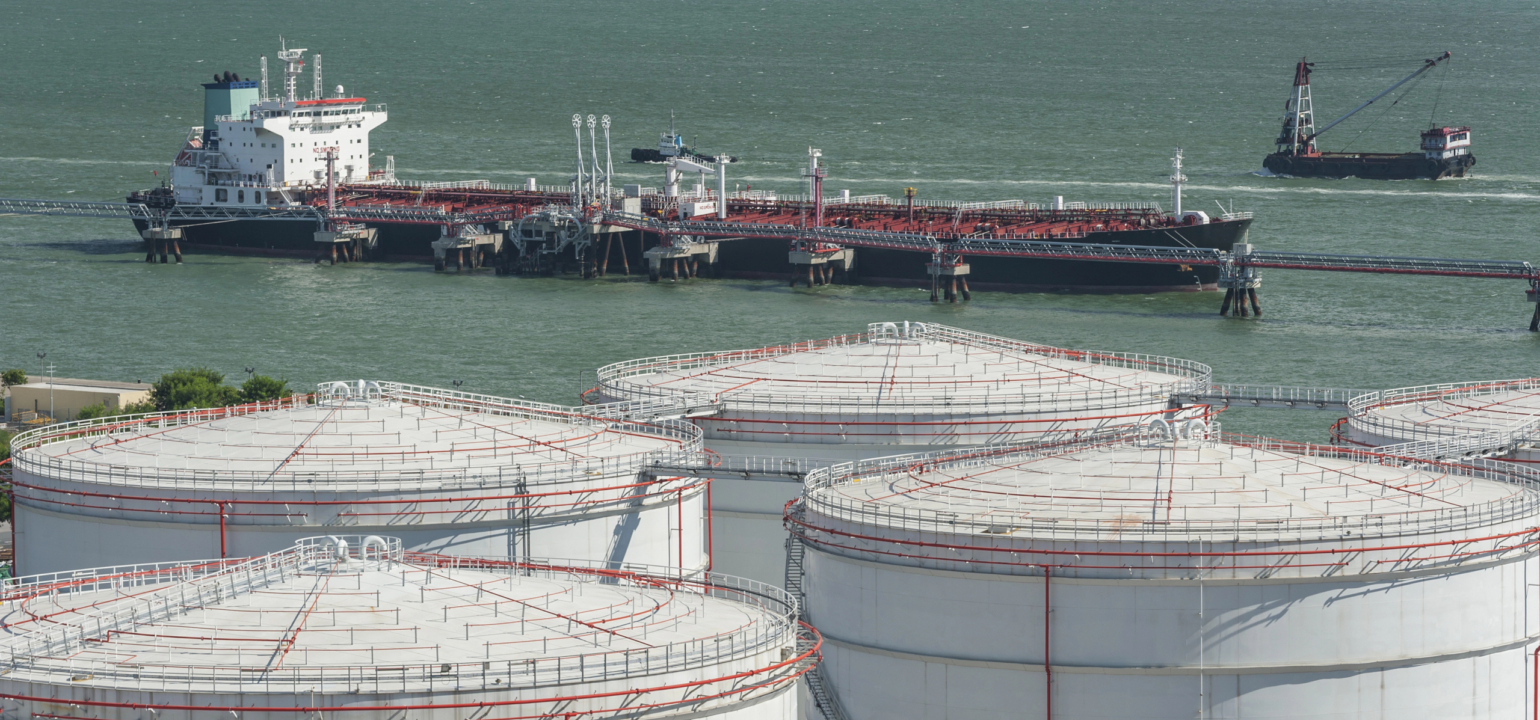
Fot.: Lee Yiu Tung, Oil storage tanker, DepositPhotos
Przeczytaj też
Comments
A blockade of the Strait of Hormuz has a significant impact on global oil and ga...
Comments
On 10 February 2026, President Sadyr Japarov issued a presidential decree dismis...
Comments
The security cooperation agreement signed in early January of this year opens ne...
Comments
On January 17, 2026, the Agreement on Marine Biological Diversity of Areas Beyon...
Web development & Web design: Artixen.net | © 2024 Oppotrunity