Notes
Syria’s Window of Opportunity: Risks to Potential Development
The conflict between the United States and Israel on the one hand, and Iran on t...


25.05.2026
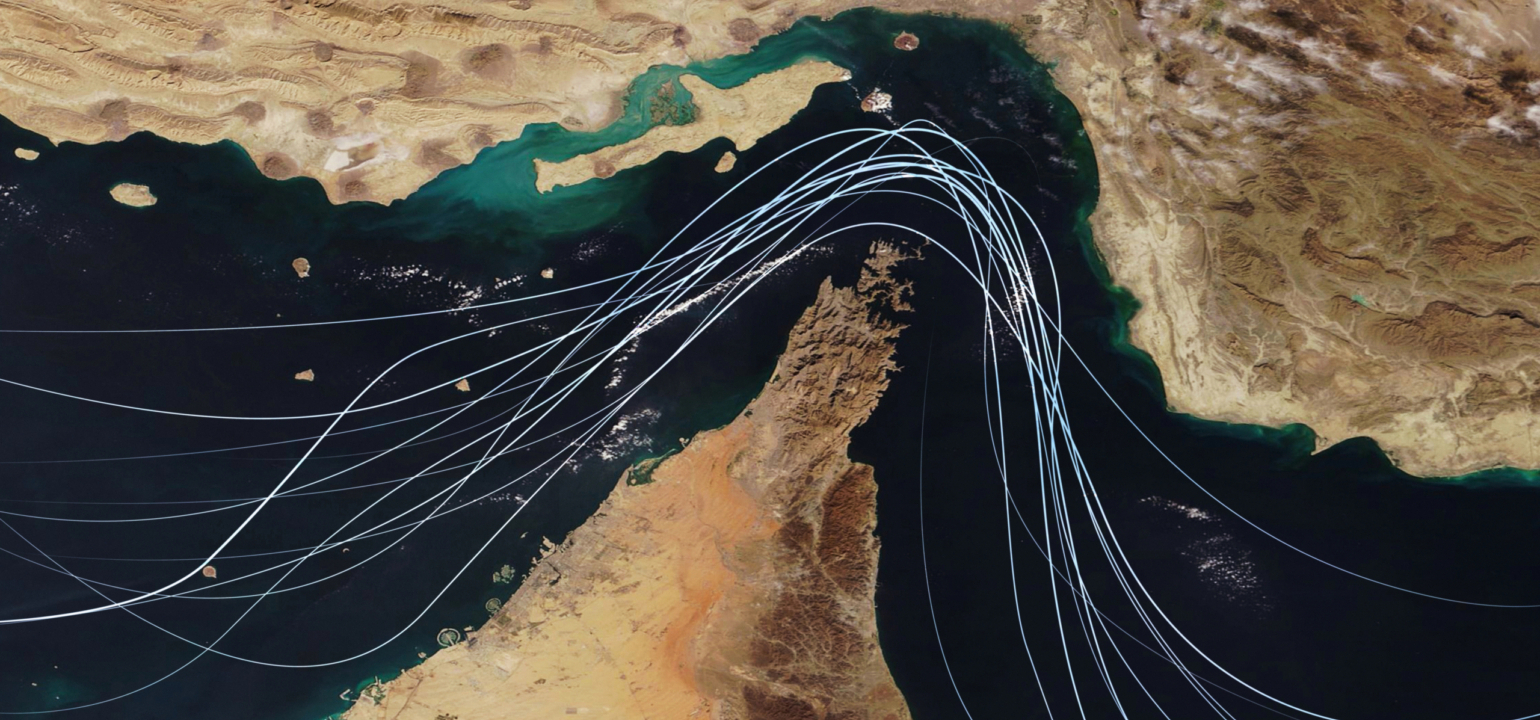
The Strait of Hormuz is not only a critical route for oil and gas exports but also one of the most important hubs of the global data infrastructure. Disruptions to the operation of submarine fiber-optic cables would constitute a blow to the digital sector of GCC economies — another pillar of their development model, alongside hydrocarbons.
Institutionalizing Control over the Strait
On May 9, channels affiliated with the Islamic Revolutionary Guard Corps – Fars and Tasnim – published two similar articles. They pointed out that the hyperscalers of Amazon, Google, and Microsoft in the GCC (Gulf Cooperation Council) states depend on cables running across the Strait’s seabed, which is controlled by Iran. Therefore, Tehran should impose licensing fees on these American companies and compel them to operate formally in accordance with Iranian regulations.
The Tasnim News Agency cited Article 34 of the United Nations Convention on the Law of the Sea (UNCLOS)[1], arguing that transit rights granted to shipping [through the Strait of Hormuz] do not extinguish Iran’s sovereignty over the seabed itself. The agency omitted Article 79, which explicitly protects the right to lay and maintain submarine cables.
Due to the sanctions currently in force, there is no legal mechanism through which American companies could pay such fees. However, the manner in which these arguments were framed suggests that Iran’s objective may not be the fees themselves, but rather the institutionalization of control over the Strait and its submarine cable infrastructure.
A Region Wired by Cables
Up to 98% of the world’s data traffic is transmitted through submarine cables, with the remainder handled by satellites. Cable connections are not only more stable but also significantly faster than satellite communications (averaging 340 terabits per second for submarine cables compared to 100–200 gigabits per second for satellite links). Submarine cables are indispensable to the functioning of the modern information-based economy.
Four cables currently pass through the Strait of Hormuz, which is 54 km wide at its narrowest point and has an average depth of 50 meters: FALCON (FLAG Alcatel-Lucent Optical Network), GBICS/MENA (Gulf Bridge International Cable System/Middle East North Africa Cable System), AAE1 (Asia Africa Europe-1), and OMRAN/EPEG (Oman-Iran/Europe-Persia Express Gateway). Three additional cables are planned: FIG (Fiber in Gulf), linking the GCC states and Iraq; the Khaleej branch of SEA-ME-WE-6 (South East Asia–Middle East–Western Europe 6); and the Pearls branch of the 2Africa cable encircling the African continent.
Within a 200 km radius of the Iranian side of the Strait are several important landing stations – locations where submarine cables emerge from the water and connect to terrestrial infrastructure. These include Dubai, which serves as a landing station for three cables, and Fujairah, a port on the Gulf of Oman where twelve different cables connect to land-based infrastructure. By comparison, the largest landing station in Europe in terms of cable volume is Marseille, where eleven cables come ashore.
Operators typically purchase transmission capacity on multiple cables simultaneously, allowing data traffic to be rerouted in the event of a failure or break in one of them. Internet traffic is governed by the Border Gateway Protocol (BGP). Data packets do not select the shortest physical route; instead, routing is optimized based on available bandwidth, commercial traffic-exchange agreements, and delivery costs. As long as an alternative physical connection with available capacity exists and the operator has purchased the relevant bandwidth rights, data can continue to flow — even if the route circles the globe.
The system, therefore, possesses redundancy, although it is geographically limited to several networks that do not run through or near the waters of the Strait of Hormuz:
Oman and Saudi Arabia possess the strongest redundancy capabilities. Qatar and Bahrain are in the weakest position; in the event of damage to cables running through the Strait, they would be forced to rely on the Saudi network and the terrestrial MEETS system.
Cables – an Easy Target, Hard to Repair
Submarine cables are difficult to protect and can be severed at low cost, without clear attribution of responsibility. This makes them an ideal target for Iranian “grey zone” operations.
Fishing vessels and dragging anchors along the seabed account for approximately 86% of the average 200 annual submarine cable failures worldwide. Iran could potentially use divers, underwater drones, as well as vessels of uncertain affiliation to sever such cables. The difficulty of detection and of unequivocal attribution in grey-zone operations is illustrated by the case of the Russian tanker Eagle S, sailing under the Cook Islands flag, which damaged telecommunications and power cables in the Gulf of Finland in December 2024. Despite Estonia and Finland treating the incident as a serious interference with critical infrastructure, a Finnish court acquitted the crew due to a lack of evidence of intentional action.
Cable repair can take anywhere from one day to several months (on average, 44 days) and cost between USD 1–3 million per operation. In a conflict environment, repair times increase, costs rise, and maritime insurance premiums escalate. Following Houthi attacks in the Red Sea in 2024, insurance costs for cable-laying vessels operating in the area doubled, reaching up to USD 150,000 per day. Four companies account for the majority (82.7% of submarine cable length laid since 2020) of global submarine cable installation and repair: France’s ASN, the US-based SubCom, Japan’s NEC, and China’s HNM Tech (which, however, does not operate any networks in the region). SubCom operates 8 vessels, ASN 7, while NEC does not own vessels and instead charters the Norwegian ship, Normand Clipper. At present, only two vessels are available in the region, both belonging to ASN: the Île de Batz, stranded in the Saudi port of Dammam, and the Île de Bréhat, operating in the Arabian Sea.
Damage to a cable in the Strait of Hormuz would entail not only repair costs but also a reduction in already limited global cable repair capacity in other regions.
The Impact of a Physical Cable Cut on the Local Digital Architecture
Although a complete disconnection of GCC states from the internet is unlikely due to existing redundancy and the availability of alternative routes, the disruption of a submarine cable would generate substantial costs for regional economies.
In the event of traffic rerouting, latency increases while overall bandwidth capacity decreases. This is particularly significant for the financial markets of the Gulf states, which are among the most digitised and deeply integrated into the global capital system. The region hosts key stock exchanges, including the Dubai Financial Market (DFM) and the Abu Dhabi Securities Exchange (ADX) in the United Arab Emirates, the Saudi Exchange (Tadawul) —- the largest stock exchange in the Middle East by market capitalisation — and the Qatar Stock Exchange (QSE) in Doha. These markets are heavily dependent on algorithmic trading and colocation infrastructure, where competitive advantage is measured in microseconds and milliseconds. Even minimal transmission delays can disrupt arbitrage mechanisms between regional exchanges and global financial centres such as London, New York, and Singapore, resulting in losses from mispricing, delayed updates, and reduced liquidity.
Disruptions also have a direct impact on clearing and payment systems, including the SWIFT infrastructure and local Real-Time Gross Settlement (RTGS) systems used by GCC central banks. Delays in data synchronisation may interfere with cross-border settlements, derivatives linked to oil and gas prices, and automated liquidity management systems.
Degradation of connectivity also affects logistics systems, aviation operations, e-commerce, and energy infrastructure, where increasingly sophisticated digital grid management systems and real-time automation are employed.
Raising Costs Without Cutting Cables
Iran may increase the cost of operating the Gulf’s digital economy without physically destroying submarine cables.
The ongoing conflict is already affecting planned investments. The Iraq–UAE WorldLink Transit Cable Project was intended as a submarine extension of an existing terrestrial cable linking Turkey and Iraq to Abu Dhabi. The concept, with an estimated value of USD 700 million, was based on positioning the Gulf as a safer alternative to the Red Sea connectivity corridor between Europe and Asia. The continuation of the project, announced in 2024, is now uncertain.
Risks and costs associated with submarine cable deployment are also causing delays in the installation of planned infrastructure. This applies to the aforementioned Khaleej branch of SEA-ME-WE 6, FIG, and Pearl/2Africa. The latter is financed by a consortium including Saudi STC, Emirati e&, and Meta. SEA-ME-WE 6 includes stakeholders such as Microsoft, Saudi Mobily, and Batelco. FIG, in turn, is a project led by Qatar’s state-owned operator Ooredoo.
The current situation also complicates the repair and maintenance of submarine cables that may be damaged through accidental or non-intentional incidents.
Iran Targets Digital Development
Each GCC state, as part of its strategy to move away from a hydrocarbon-based economy, is implementing long-term economic programmes in which the digital economy, artificial intelligence, and data infrastructure constitute key pillars of diversification.
The United Arab Emirates is the most advanced in this process. The country operates 52 active data centres, of which 34 are located in Dubai and 14 in Abu Dhabi. It is also developing large-scale AI campus projects, including “Stargate UAE” in Abu Dhabi, with a planned computing capacity of 1 GW in its initial phase and up to 5 GW at full scale, placing it among the largest planned computing complexes globally. Saudi Arabia, under the restructured Saudi Vision 2030 strategy, has prioritised the AI sector and cloud infrastructure expansion since 2023. The state-owned AI company HUMAIN, established in May 2025, has entered into partnerships with Nvidia, AWS, and Google to develop data centres with a combined capacity of 2 GW in the Riyadh area. Existing Saudi data centres are concentrated around Riyadh (9 data centers) and Dammam on the Arabian Gulf coast (6). Qatar, under Qatar National Vision 2030, has built 7 data centres, Bahrain operates 8, and Oman has 12 data centres located along the Gulf of Oman coastline, within a 300 km radius of Iran.
Their concentration and strategic importance for regional development models make them potential targets of Iranian operations. On 1 March, Shahed drones reportedly damaged two AWS data centres in the UAE, temporarily disabling banking applications for approximately 50 million users.
Iran may also indirectly increase costs for GCC economies by affecting energy supply stability, which underpins the competitiveness of regional data centres. Average electricity prices for large consumers in GCC states range between USD 0.05–0.10 per kWh, compared to USD 0.15–0.25 per kWh in Europe. In the event of escalation and disruption of energy infrastructure, rising electricity costs directly translate into higher operating expenses for data centres, which account for as much as 30–60% of their total operating costs.
Conclusions
The Iranian threat demonstrates that digital economy infrastructure is becoming a new domain of international competition. Submarine cables, landing stations, and data centres are increasingly acquiring a strategic role comparable to that of pipelines, LNG terminals, or power plants. Their disruption does not result in a complete “shutdown of the internet”. Nevertheless, it does enable the adversary to raise the operating costs of the digital economy, destabilise financial flows, and deter investment.
Iran has limited conventional power projection capabilities against GCC states and the United States; however, the Gulf’s digital infrastructure provides Tehran with a relatively low-cost and asymmetric instrument of pressure that can be employed below the threshold of open warfare. In practice, even partial damage to cables or the mere elevation of perceived risk is sufficient to increase insurance costs and delay investment decisions. The United Arab Emirates is particularly exposed, as its digital and financial infrastructure is located in proximity to Iran. Saudi Arabia possesses greater strategic depth, with a significant share of its digital infrastructure concentrated around Riyadh. Bahrain and Qatar have the lowest levels of network redundancy, while Oman — due to its access to the Gulf of Oman and the Arabian Sea — benefits from a more resilient configuration. These disparities in threat perception may further undermine cooperation within the GCC framework.
Despite these risks, major technology companies are not withdrawing from the region. The Gulf states remain among the most attractive locations for AI infrastructure development, owing to low energy costs, access to sovereign wealth capital, and their geographic position between Europe and Asia. Continued investment in data centres, submarine and terrestrial networks, and AI campuses will, however, increase the costs of their protection, operation, and insurance.
Conclusions for Poland and the European Union
The case of the Gulf states demonstrates that digital resilience does not depend solely on the number of submarine cables, but also on the ability to repair them rapidly in crisis conditions. In peacetime, damage to submarine infrastructure is relatively easy to restore; however, in high-risk environments, insurance costs rise sharply, response times increase, and logistical constraints become more severe. This also applies to Europe and the Baltic Sea region. EU member states are well interconnected, and a complete disconnection from the internet is highly unlikely. However, risk perception remains uneven — Finland and the Baltic states are more dependent on a limited number of connections than, for example, Poland.
In practical terms, this implies the need for investment not only in redundancy of cable routes, but also in repair capabilities: fleets of specialised vessels, submarine infrastructure monitoring systems, and technologies enabling faster localisation of faults. At present, global cable repair capacity remains highly constrained, with most of the market concentrated in the hands of four companies. As artificial intelligence and the data-driven economy expand, submarine cables will increasingly become strategic assets, and future conflicts are likely to be more frequently directed at these digital arteries of the global economy.
[1] Which Iran has never ratified.
Foto.: alonesdj, Satellite view of the Strait of Hormuz with white graphic lines representing maritime traffic, depositphotos, Standard License
Przeczytaj też
Notes
The conflict between the United States and Israel on the one hand, and Iran on t...
Notes
Expert seminars
The Constitutional Court of the Republic of Kazakhstan published the draft of a ...
Web development & Web design: Artixen.net | © 2024 Oppotrunity